
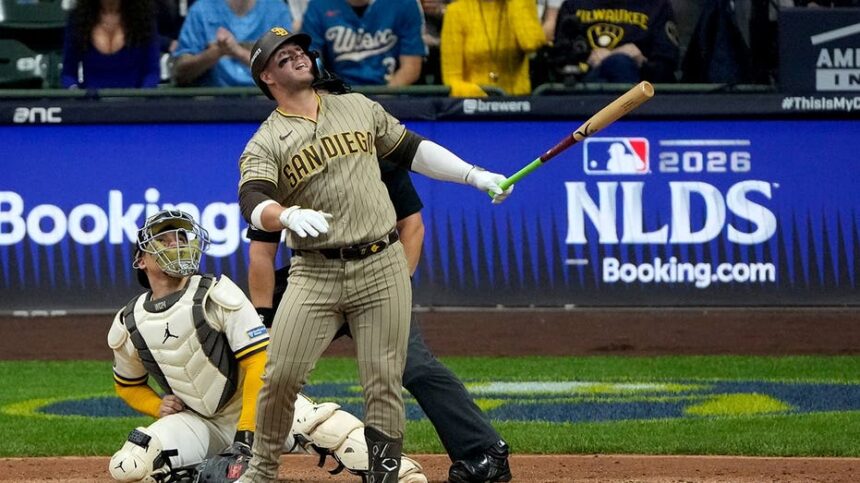
If there’s one thing the Major League Baseball postseason always delivers, it’s drama. And Saturday night’s game between the San Diego Padres and Milwaukee Brewers certainly had more than its fair share.
The Brewers entered the game and the series as big favorites, thanks in large part to likely NL Cy Young Award winner Jacob Misiorowski starting game one. Misiorowski has been nearly unhittable this season, with a minuscule 1.80 ERA, just 96 hits allowed all season, and 252 strikeouts in 174.2 innings. But the Padres have been baseball’s hottest team down the stretch, and were able to force him out after pushing across two runs in just four innings.
But the Brewers battled back, tying the game on a Jackson Chourio homer and taking the lead late on another from William Contreras. The Padres missed an opportunity in the top of the 8th, but started the 9th with the heart of their lineup facing closer Trevor Megill. Dustin Harris singled to lead off the ninth, Manny Machado struck out, and Ty France launched what’s now become one of the most controversial fly balls in recent postseason history.
While it looked at first glance like a potential go-ahead home run, or might fly harmlessly foul, France hit the ball so high it banged off the roof support system at American Family Field and fell into the field of play just onto the warning track in left field, where Jackson Chourio caught it for an out.
Several minutes of discussion followed, with the umpires ruling on the field that it was, in fact, a fair ball and effectively a fly ball out. Many fans, and some of the players, were clearly confused, assuming that a ball hitting the roof would become immediately “dead” and the play restarted.
By rule though, there’s no question that the umpires made the correct call. Major League Baseball’s ground rule page, specifically covering American Family Field, covers this exact situation. If the “Batted ball strikes roof, roof truss, roof cable, or any cabling over fair territory,” the rule states, it’s considered “In Play.”
“If caught by fielder,” it continues, “batter is out, and runners advance at own risk.”
That’s exactly what was determined on the field, and what the replay review confirmed. The ball was in fair territory when it hit the roof, it fell down to the field of play where it was caught by an outfielder, and the hitter is out. Controversy over, right?
Well, not exactly.
Many fans, obviously most notably Padres fans, are convinced that the ball would have been a home run had it not hit the roof. France himself said as much after the game in the clubhouse. “You would think with all the technology we have now wed be able to make a clear call on that,” France said. “There should be something put in place right there. That shouldnt be an out. ⦠Weve got ball tracking. Weve got exit velo. Weve got projected distances. We have all that stuff.”
And that’s where the second part of the controversy has continued, and even grown. Had the ball not hit the roof, would it have been a game, and potentially series, changing home run?
France is right; we do have ball tracking, exit velocity and projected distances, thanks to the league’s Statcast operation. And those metrics all but confirmed one thing: that was