NEW YORK â A Smithsonian museum in Manhattan presents a sharply critical account of George Washington, the Revolutionary War and Americas early years, while some historical context that complicates that narrative is omitted or given less prominent treatment, Fox News Digital found.
The findings come as the Smithsonian faces heightened scrutiny from the Trump administration over how it presents American history. President Donald Trump has ordered a review of the institutions exhibits and educational materials as part of an effort to change what his administration says is an overly negative portrayal of the countrys history.
Fox News Digital visited the Manhattan branch of the National Museum of the American Indian earlier in September and found exhibits that emphasize the destruction suffered by Native communities while offering comparatively little context about the conflicts and events surrounding American military campaigns.
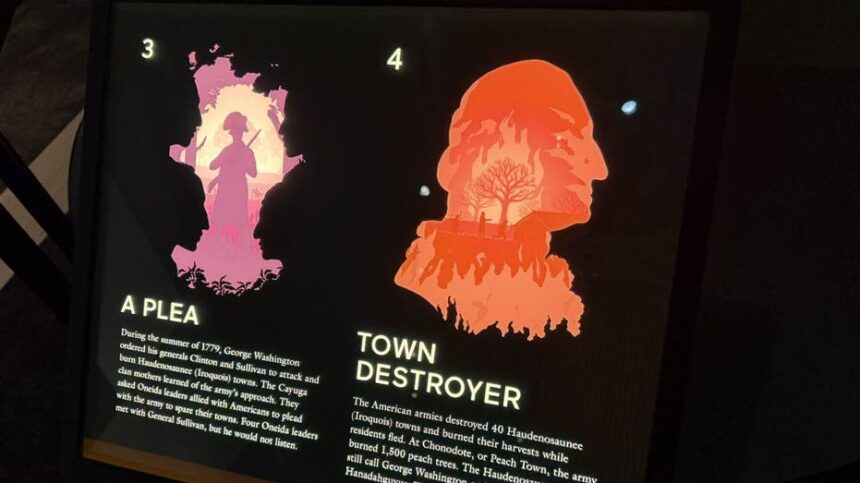
One display near the center of the museums “Native New York” exhibit features an illustration of Washingtons profile â similar to the one that appears on quarters â over a label that reads “town destroyer.”
TRUMP GIVES SMITHSONIAN DAYS TO REPLACE ‘STRANGE MODERNIST SCULPTURE’ WITH FOUNDING FATHER
The description underneath the image recounts how “American armies destroyed 40 Haudenosaunee (Iroquois) towns and burned their harvests while residents fled,” noting that “the Haudenosaunee still call George Washington and all U.S. presidents Hanadahguyus. The name means town destroyer.”
The panel does not mention the raids on American settlements that led to the campaign or explain why Washington ordered the attack.
“The American destruction of the Six Nations’ homelands came as a result of the destructive raids carried out by the Indians and American loyalists on the frontiers of New York and Pennsylvania in 1778,” an excerpt from the National Park Service reads. “The raids crippled the American Continental Army by depriving it of food and manpower and spread terror by destroying frontier settlements and taking prisoners.”
The exhibit comes as the Trump administration continues its broader dispute with the Smithsonian over how the institution presents American history. Specifically, the president has taken issue with the institution allegedly seeking to divert the telling of American history “away from Americas Founding and the Founders and towards a narrative of a deeply flawed creation of the country.”
SMITHSONIAN SHOWDOWN INTENSIFIES AS TRUMP ADMINISTRATION ISSUES A STARK NEW WARNING
The administration has threatened changes to Smithsonian funding and federal-agency support as it presses the institution to alter what it describes as divisive or historically inaccurate portrayals of the country.
Many of the other exhibits in the museum take a similar line to the display on Washington, highlighting the alleged brutality of American settlers while downplaying the violence of natives.
One placard, recounting the history of the Iroquois between 1779 and 1804 from the point of view of a native woman, states that “it was peaceful, she said, until the white men began their revolution.”
For roughly 100 years, between 1609 and 1701, the Iroquois were engaged in a series of conflicts with other native tribes over access to animal pelts.
Even before the Trump administrations , the National Museum of the American In