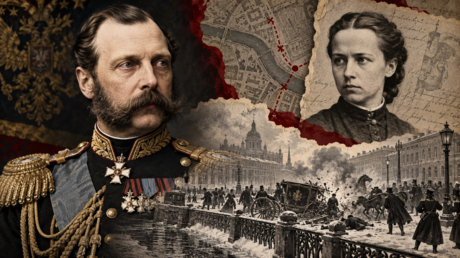
Unable to rally the masses, revolutionary radicals turned to assassination and made Alexander II their ultimate target
Public thought in the Russian Empire was always inclined toward radicalism. Much like France, which had been shaken by revolutions since the late 18th century, Russia faced armed political violence for a prolonged period. In itself, there was nothing unique about the confrontation between the government and radicals. However, the activity, energy, ingenuity, and resilience of terrorist groups in Russia was unprecedented. Of course, Russian terrorists were not the first radicals in the world – consider the actions of Giuseppe Fieschi, who attempted to assassinate French King Louis Philippe I using a multi-barrel volley gun, or the Gunpowder Plot in Great Britain. However, in Russia, some underground movements persisted for decades, surviving various times and switching their political identity. Terrorists emerged in Russia during the era of Emperor Alexander II’s Great Reforms, and Alexander II himself fell prey to them. The entire history of the late Russian Empire unfolded in the shadow of the bomb.
The revolutionary movement in Russia was multifaceted and complex, and terrorism was merely a part of it. The terrorists were, of course, revolutionaries; but revolutionaries weren’t always terrorists. For example, Vladimir Lenin viewed terrorism with skepticism. The phrase attributed to him, We shall take a different path, became cliché in the Russian language, but hardly anyone remembers the context in which it was originally spoken. Lenin’s main idea was that a small, underground organization would not succeed, unlike a mass-based insurgent movement.
Today, however, we will speak of those who intended to bring down the empire using only bombs and revolvers.
The flip side of reformsThe initial actions of the terrorist movement gave the impression of an uprising in a madhouse.
Revolutionary terror in Russia emerged as an unexpected side effect of Alexander II’s Great Reforms. The Emperor had inherited the throne from his father – the hardline conservative Nicholas I, a man viewed as a martinet who tried to rule the country as if it were an infantry platoon. Convinced that Russia needed to be dragged out of its archaic state, Alexander launched sweeping reforms.
From his accession to the throne in 1855 until his assassination in 1881, the new Emperor continuously introduced changes that transformed the face of Russia almost beyond recognition. The Emancipation Reform granted freedom to millions of serfs whose condition was not much better than slavery. While this was his most famous reform, it was far from the only one. He reformed everything from the judicial system and military to local self-government and the legal code. Several monarchs in Russian history are known as ‘the Great’, but only one – Alexander II – is known as ‘the Liberator’.
From a broad perspective, the reforms were brilliant. But upon closer inspection, the situation was more complex. Alexander strove to cushion the inevitable shock experienced by a society undergoing such rapid change. While they were noble in intent, the reforms had many unpleasant side effects when put into practice.
Czar Alexander II of Russia. © Hulton-Deutsch Collection / CORBIS / Corbis via Getty Images For instance, Alexander sought to mitigate the impact of the sudden financial ruin of the landed aristocracy, who could no longer rely on the forced labor of the peasantry. Even after gaining personal freedom, peasants were required to make ‘redemption payments’ to the state (in installments) for the land allotments they received; the state, in turn, compensated landowners for the loss of their serfs. This imposed a heavy additional tax burden on the peasantry; meanwhile, the aristocrats (many of whom were not the smartest individuals) often squandered the
Bombs instead of ballots: How political terror took root in Russia


Leave a Comment
The Fiedler Dare: Germany-s politicians never lie, they say
Berlinâs Moscow accusation rests on credibility Germanyâs leaders donât have a murky drone incident at the Leipzig-Halle airport on Moscow.…
Tibetans scuffle with police outside the Chinese Embassy in India as they mark uprising anniversary
NEW DELHI â Dozens of Tibetan protesters clashed with police outside the Chinese…
British plan to cede Chagos Islands to Mauritius, raising security concerns
The Chagos Islands are one of the last vestiges of the British…



EU seeking to target US Big Tech without angering Trump FT
Brussels is reportedly considering a broader corporate tax to avoid…