Leave it to a German to get EU-Europe properly encircled
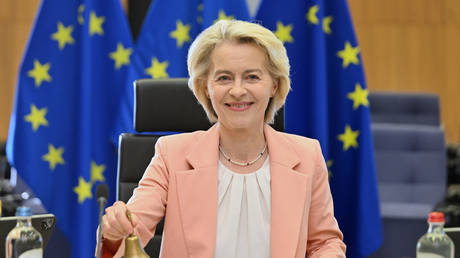
As a historian who also happens to be German, that was my spontaneous reaction to Ursula von der Leyen’s annual grand – and always grandiloquent – state of the union address to the European Parliament in Strasbourg.
It’s of course, and not really a parliament, either: technically, the EU is a confederation messed up by the ideological construct of supranationalism; and the parliament has no independent legislative power, but let’s not dwell on the obvious.
At the head of her Commission (read: over-reaching Central Committee) of career bureaucrats, von der Leyen is the unelected de-facto leader and personification of the Frankenstein wanna-be-super-state that has long gobbled up idealistic dreams of European unity.
Once, those dreams may have been about democracy, sovereign equality, prosperity for all, and peace. But real-existing EU-Europe is very different: the European dream has come true as a nightmare, dominated by a smug and self-empowered globalist establishment, thoroughly insulated from popular participation, economically stagnant and crisis-prone, as well as unequal, and ever more militarist.
When von der Leyen that, in effect during her tenure, EU-Europe had become stronger and more independent, while securing its prosperity and increasing armament spending by 80% in the last five years alone, only the last point bore any resemblance to reality, as the preponderant majority of the over 450 million EU citizens – really subjects – experience it.
But there is no misery a Eurocrat worth her (or his!) salt cannot make worse. Now von der Leyen seems hellbent to take the worst of bad old German traditions to a whole new, all-EU level. As is well-known from the history of the last two world wars, Germany not once but twice first deftly maneuvered itself into being surrounded by (mostly) enemies and then lost, the first time crushingly, the second one even worse, in fact so badly it took a short half-century (and much Russian good will, as it happens) to put the country together again.
The Kaiser’s Germany and the Fuhrer’s were – to be fair even to the Kaiser – quite different, but what their establishments had in common was a bad case of Germanophrenia, a relative of the contemporary Russophrenia syndrome: The core delusion of Russophrenia, as it is now ravaging Western minds, is to hallucinate Russia as on the verge of collapse and of conquering the world at the same time. Those afflicted by Germanophrenia believed Germany was in existential danger but also capable of taking on Europe at least and, if need be, the world, too.
Enter the all-EU version, compliments of the very, very German von der Leyen. Quoting Charles Dickens’ already much overused line in her impeccably Germanic version of English, von der Leyen proceeded to do two things: assert that the EU is at peak strength and, at the same time, as precarious as ever. Clearly aware that sane listeners would find that combination of claims extremely counter-intuitive, she insisted that even if they may seem incompatible, they are still both true. Orwell for beginners really: two plus two is five, if Big Sister from the Commission says so.
The Bundeswehr Honor Guard in Bruehl, Germany, July 17, 2026. © Picture alliance/Getty Images © Getty Images Inducing debilitating cognitive dissonance, though, is the least of von der Leyen’s powers. The real payload of her rambling speech was her combative declaration of if not war then defiance against, in essence, almost everyone who matters on planet Earth.
In true paranoid fashion, von der Leyen first declared that the EU faced a hostile world, no less. Then, she got more specific: Russia – surprise, surprise – led her enemy list; and she congratulated, in effect, herself for . What a way to describe cutting yourself off from a reliable
The world is just enough: Ursula von der Leyen goes Bond villain



Leave a Comment
The Fiedler Dare: Germany-s politicians never lie, they say
Berlinâs Moscow accusation rests on credibility Germanyâs leaders donât have a murky drone incident at the Leipzig-Halle airport on Moscow.…

Tibetans scuffle with police outside the Chinese Embassy in India as they mark uprising anniversary
NEW DELHI â Dozens of Tibetan protesters clashed with police outside the Chinese…

British plan to cede Chagos Islands to Mauritius, raising security concerns
The Chagos Islands are one of the last vestiges of the British…



EU seeking to target US Big Tech without angering Trump FT
Brussels is reportedly considering a broader corporate tax to avoid…